









Types of Horse Harness Shaft Tugs
(See this article with more photos of the harnesses in use here.)
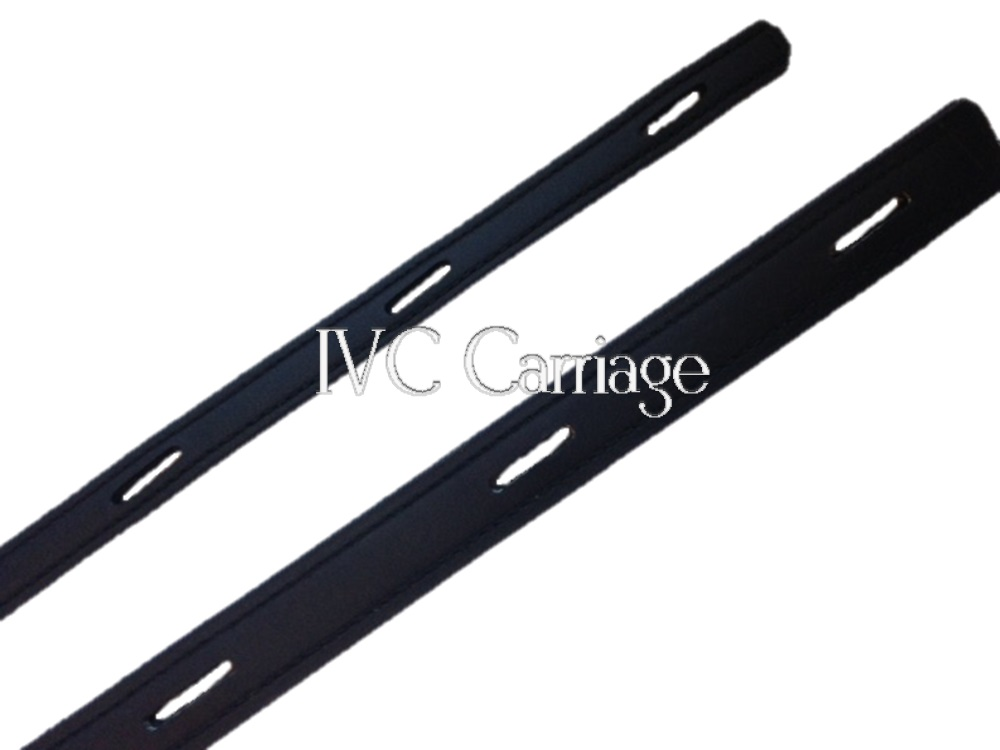
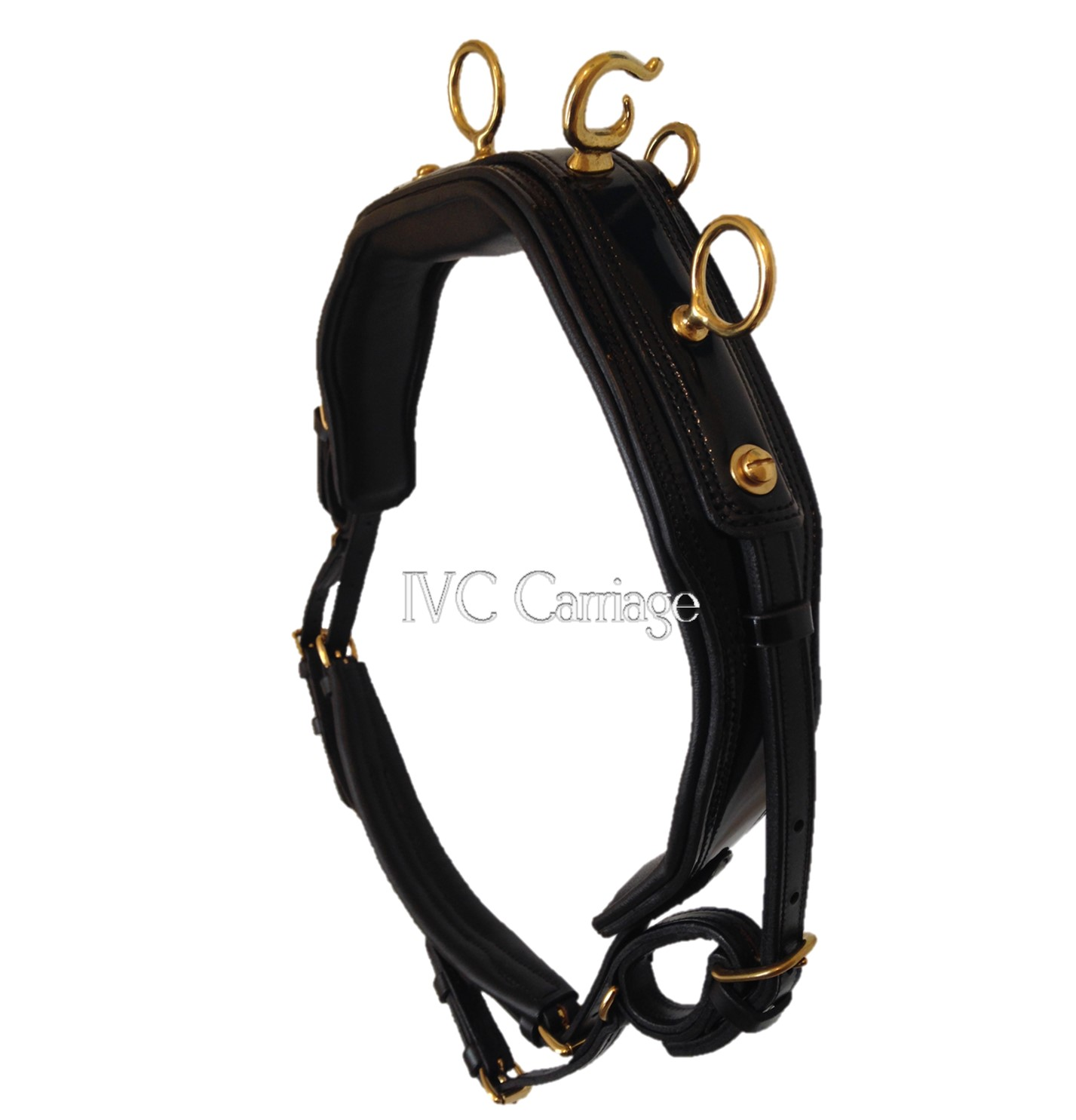
Shaft tugs are a part of a single horse harness. They buckle to the tug bearing straps on the harness saddle to hold the shafts of the vehicle. Shaft tugs come in a few varieties to suit the vehicle for which they are being used. Some people familiar with other forms of horse driving, such as draft horse driving, tend to call them shaft loops instead of tugs.
Tugs always require a method to hold them down so the vehicle shafts do not flip up and tip over backwards. This method varies depending on what type of tugs are employed.
Open Tugs

The term “open tugs” is a bit of a misnomer, as open tugs do not actually open. The reason they are called open tugs is that they are sewn to form an open oval, and do not cinch down tightly around the shafts like other forms of tugs, which we will discuss later. Open tugs allow the shafts to move more than tugs that wrap tightly around the shafts. Open tugs are most typically used on traditional carts and carriages with straight shafts that end at the horse’s point of shoulder. They are the simplest form of tugs.
Open tugs use two different methods of holding the shafts down. The first is by a tail that is buckled into the overgirth (or bellyband) on the girth. With this type of setup, breeching on the harness is imperative because the shafts can slide through the tugs.
 The second method is by a wrap strap attached to the girth. Open tugs used with a wrap strap girth do not have a tail attached to the bottom of the tugs. The wrap strap on the girth wraps in a particular way around the shafts on each side of the tugs and buckles back into itself. If the wrap strap is wrapped tightly, it can act as the braking system for the vehicle instead of breeching, although this method transfers the motion of the vehicle to the horse, and should only be used for short timeframes on a flat surface, like a show ring. If the wrap strap is not cinched down tightly, it is more comfortable for the horse, but then breeching needs to be used for the braking system.
 French Tugs

A French tug is also a more traditional type of tug that has a metal cradle on which the shaft rests. A second strap wraps over the shaft tightly, threads back through the hardware of the tug, and buckles into the overgirth. French tugs hold the shafts tightly, creating less movement of the shafts. French tugs are seen most often used with curved shafts. With curved shafts, the tugs are buckled higher on the tug bearing straps than regular Open tugs with straight shafts.
Quick Release Tugs

Quick Release tugs are a relatively new form of shaft tugs in the history of carriage driving. They were primarily created to be used with the closed-end shafts on a modern vehicle used for the marathon portion of a Combined Driving Event. Marathon shafts are much shorter in length than traditional shafts, stopping at the horse’s saddle instead of the point of the shoulder. The shorter shafts allow the horse more room in the front to bend around the tight spaces of a marathon course, and are less likely to get hooked on an obstacle like traditional straight shafts may. Shorter shafts cannot be used with regular Open tugs, or the shafts would fall out of the tugs. Therefore, a marathon shaft has a ring on the end by which the shaft is supported and attached to the saddle. Shaft tugs used with marathon shafts need to open to attach around the ring on the shafts.
 A Quick Release tug closes around the marathon shaft, and the tug bearing strap slides into the quick release hardware, locking the tug around the shaft. The shaft is released from the tug by pulling up on the tug bearing strap, thus opening the hardware that is holding the tug closed. The quick release hardware allows the tug to open like a French tug, but without having to unbuckle the strap like a French tug and pull it through the hardware in order to release the shaft. Quick Release tugs have a strap attached to the bottom to buckle into the overgirth, holding the tugs down.
Since Quick Release tugs allow for an open oval loop once they are closed, they can be used with the greatest variety of shafts, short or long, straight or curved. They are not necessarily considered a safety feature as the name implies, as there are other ways to release a horse from a carriage in an emergency. However, as indicated above, they are quicker to release than French tugs or Wrap tugs. People who struggle with thick or stiff tug bearing straps on the saddle may find the Quick Release tugs a little more difficult to use. In that case, French tugs may be the better solution.
Marathon Wrap Tugs

Wrap tugs are another more modern form of tugs that “open” so they can be used with closed-end marathon shafts. They are similar to French tugs in that they wrap around the shafts and thread back through their own hardware to buckle into the overgirth, but they do not have the metal cradle to support the shafts like French tugs do. Some harness makers are constructing Wrap tugs to have some support of the shafts with curved material of the tugs themselves. If the tug has some form of a cradle, the tug will support the shaft while the user threads the end of the tug back through the tug before buckling the end into the overgirth. If the tug doesn’t have some form of cradle, the user has to hold the shaft up while buckling the tug. The shaft may also slip down unless the tug is buckled tightly into the overgirth. By nature of how they are made, Wrap tugs do not tighten down as hard around the shaft as French tugs do. However, they are considerably less expensive because of their simple hardware.
As you can see, it is necessary to match the tugs on your harness to the vehicle you will use. As always, if you have questions about any parts of the harness, please contact us!
Go to all IVC Educational Blog Posts
If you have arrived at this blog post directly, there is much more to see and read in our full blog!


- Choosing a selection results in a full page refresh.
1 comment
Andrew Croome
Very helpful.Thankyou.